Skip to content Skip to footer

Molecular Biophysics and Bioenergetics Group

Group Members:

  • Prof. dr hab. Květoslava Burda - kierownik
  • Dr hab. Renata Szymańska, prof. AGH
  • Dr Joanna Fiedor
  • Dr Aleksandra Orzechowska
  • Dr inż. Agnieszka Trela-Makowej

AGH Priority Research Areas – PRA 5

Materials, technologies, and processes inspired by nature: biotechnology, bioinspirations in engineering and materials science, biosensors, bioenergetics, biocatalysis, biocomputers, and biocomputation

Task:

Studies on the physico-chemical properties of biological systems subjected to external stress factors and exposure to nano(bio)particles.

Keywords:

phototrophic bacteria, bioremediation, anaerobic and aerobic photosynthesis, algae, higher plants, photosynthetic complexes, prenyllipids, vitamins, prooxidants, antioxidants, oxidative stress, reactive oxygen species, plant secondary metabolites, stress factors, biological membranes, civilisation diseases, red blood cells, haemoglobin, metallic and organic nanoparticles, carbon nanotubes, bionanotechnologies, bioenergetics

Scope of research:

  • electron and energy transport within type II photosystems;
  • the influence of the dynamics of photosynthetic complexes on their activity and the kinetics of the processes taking place within them;
  • the mechanism of oxygen evolution in photosynthesis;
  • the xanthophyll cycle in higher plants and diatoms - modelling;
  • molecular mechanisms of bacterial anaerobic photosynthesis;
  • bioremediation, phototrophic bacteria in environmental and application research;
  • structure, organisation and physico-chemical properties of native and model dye-protein-lipid systems;
  • research into self-organising hybrid systems with a potential application in the production of bio-energy;
  • effects of heavy metals, selected nanoparticles and ‘anti-fouling’ coatings on the photosynthetic activity of cyanobacteria, algae and higher plants, in vitro and in vivo studies;
  • non-invasive thermal studies of plants in response to abiotic factor;
  • structural and functional characterisation of novel antioxidants from natural sources;
  • antioxidant and non-antioxidant properties of vitamin E;
  • carotenoids as antioxidants, prooxidants and modulators of the physico-chemical properties of native and modified biological systems, role in oxidative stress;
  • nano-carriers for natural antioxidants;
  • effects of endo- and exogenous nanoparticles on physico-chemical properties of unchanged and pathological cells;
  • impact of metallic and organic nanoparticles on the development of civilisation diseases;
  • effects of ionising radiation on the stability and functioning of red blood cells;
  • functionalisation of carbon nanotubes and study of their physico-chemical properties and interaction with selected biological systems.

Cooperation

national

  • John Paul II Kraków Specialised Hospital, Kraków
  • Faculty of Medicine, Collegium Medicum, Jagiellonian University, Kraków
  • Faculty of Biochemistry, Biophysics and Biotechnology, Jagiellonian University, Kraków
  • Department of Biology, University of Warsaw, Warszawa
  • Jerzy Haber Institute for Catalysis and Surface Physicochemistry PAS, Kraków
  • H. Niewodniczański Institute of Nuclear Physics, Polish Academy of Sciences, Kraków
  • Faculty of Chemical and Process Engineering, Warsaw University of Technology, Warszawa
  • Faculty of Physics, Astronomy and Applied Computer Science, Jagiellonian University, Kraków
  • Franciszek Gorski Institute of Plant Physiology, PAS, Kraków
  • Malopolska Biotechnology Centre of the Jagiellonian University, Kraków
  • Solaris National Synchrotron Radiation Centre, Kraków
  • other AGH University units

international

  • COST CA21146 project groups
  • University of Zaragoza, Spain
  • University of Natural Resources and Life Sciences, Vienna, Austria
  • European Synchrotron Radiation Facility, Grenoble, France
  • Laboratoire de Chimie Physique, CNRS, Université Paris Sud, France
  • University of Bielefeld, Germany
  • Max Planck Institute of Molecular Plant Physiology, Golm, Germany
  • Photon Systems Instruments spol. s. r. o. (Czech Republic)
  • Ruđer Bošković Institute, Zagreb, Croatia
  • Technical University of Cluj-Napoca Cluj-Napoca, Romania
  • Amazonian Materials Group, Federal University of Amapá (UNIFAP), Brazil
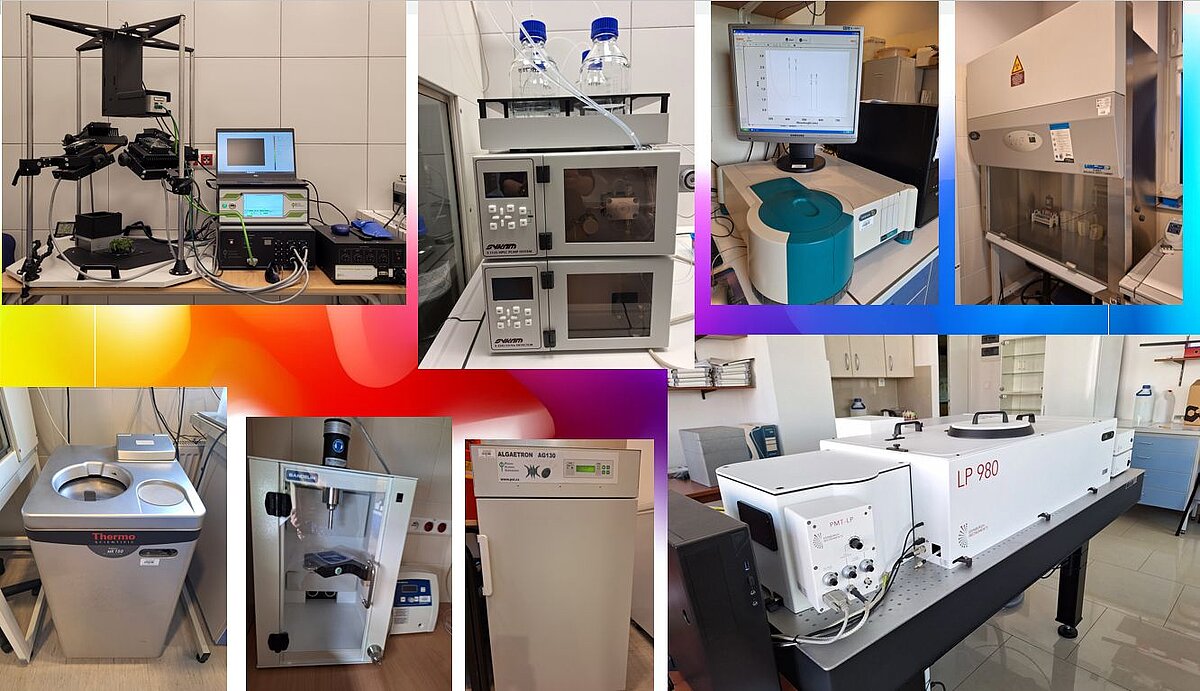
Research facilities

  • spectrophotometer UV-VIS Cary50Bio (Varian)
  • transient absorption spectrometer (Edinburgh Instruments)
  • spectrofluorometer CaryEclipse (Varian)
  • fluorometer FL3000 (Photon System Instruments)
  • fluorometer Leaf-Clip FL3500/LC (Photon System Instruments)
  • thermoluminescence measuring system TL300/HT (Photon System Instruments)
  • the high-resolution thermal imaging unit (Photon System Instruments)
  • HPLC Sykam S500 (Niemcy) - atomic force microscope (Nanosurf)
  • atomic force microscope 5500 (Agilent Technologies) – in collaboration with the Department of Solid State Physics, WFiIS
  • vertical electrophoresis set Mini Protean Tetra Cell (Bio-Rad)
  • horizontal electrophoresis set Sub-Cell GT (Bio-Rad)
  • former gradient Mini-Protean 3 Multi-Casting Chamber (Bio-Rad)
  • Algatron AG130 (Photon System Instruments)
  • cell culture chamber NU-5500 (NuAire)
  • lyophiliser (Labconco, FreeZone 1)
  • ultra-centrifuge Sorvall MX150 (ThermoScientific)
  • laboratory centrifuges (ThermoScientific Multifuge X1R; Eppendorf Minispin Plus)
  • laboratory centrifuges (type 358A, Elpin, PSU-20i, BioSan, vortices)
  • minirotators BioRS-24 (BioSan) - laboratory evaporator R-3 (Buchi)
  • thermoblock (Major Science) - mini-extruder (Avanti Polar Lipids, Inc)
  • ultrasonic cleaner (Ultrasonic H-D, JP Selecta)
  • ultrasonic homogeniser Sonoplus (Bandelin)
  • laboratory balances (Radwag PS1000/C/2; Radwag PSS3500/C/2; Sartorius CPA224S-oCE; Mettler Toledo AT261 delta Range)
  • laboratory lighting (Bowi 150W, Fiber Optic OSH-150N)
  • autoclave OT-4060 (Nuve)
  • distiller DE-10 (Polna)
  • low-temperature freezer ULTF (Dairei)

Stopka